The FAA Wants One Giant Air Traffic Supercenter — Here’s the Risk Nobody Is Discussing
For decades, America’s air traffic system was intentionally decentralised. If one centre went down, others could absorb the damage. The redundancy was not an accident — it was the design. Now the FAA is reportedly planning to spend $1.9 billion to consolidate multiple major en-route air traffic control centres into a single Texas-based “Supercenter,” creating the exact kind of single-point failure that modern infrastructure engineers spend careers trying to avoid.
This is not a budget story. It is not a real estate story. It is an airspace resilience story — and the flying public has almost no idea it is happening.
Photo: Ana Garnica / Unsplash
What the FAA Is Actually Planning
The proposal centres on a massive commercial facility being scouted in the Dallas, Texas area. The intent is to consolidate the work of multiple Air Route Traffic Control Centres — the facilities responsible for managing aircraft in cruise flight, between airports, across hundreds of miles of airspace — into a single location.
ARTCCs are the backbone of the national airspace system. They are not tower facilities managing takeoffs and landings. They manage the en-route phase of flight: the long stretches between departure and arrival where aircraft are cruising at altitude, separated by miles of structured spacing, handed off between sectors as they cross the country. The United States currently operates 22 of these centres, each covering a defined geographic region of airspace. They run continuously, around the clock, every day of the year.
The Supercenter concept would reduce that number. How many centres would be absorbed is not yet confirmed publicly — but the implications of even partial consolidation are significant enough to warrant serious scrutiny.
How En-Route ATC Actually Works — And Why Redundancy Matters
To understand the risk, you need to understand what these facilities actually do under pressure.
Each ARTCC is divided into sectors. A sector is a defined block of airspace — a geographic area combined with an altitude band — that one or two controllers manage at any given time. Traffic levels determine how many sectors are active. During peak hours, a busy centre might open dozens of sectors simultaneously, each staffed and active. During quiet overnight periods, sectors are combined and managed by fewer controllers.
When a facility experiences a problem — a power disruption, a systems failure, a severe weather event forcing an evacuation — the response is not chaotic. It is procedural. Neighbouring ARTCCs absorb responsibility for the affected airspace. Traffic through the impacted region is reduced through flow control: aircraft on the ground hold at their departure airports, arrival rates at downstream airports are capped, and the overall volume of flights transiting the affected area drops to match what the absorbing facilities can safely handle.
This system works because the load is distributed. Neighbouring centres exist precisely to catch each other. The geographic separation between facilities means that a localised problem — a storm, a grid failure, a cyberattack — affects one centre, not the whole network.
A Supercenter changes that calculus entirely.
The Single-Point-of-Failure Problem
Consolidating multiple ARTCCs into one building does not eliminate the airspace those centres manage. The airspace stays the same size. The traffic volumes stay the same. What changes is where the humans and systems controlling that airspace are physically located.
If the Supercenter goes offline — for any reason — the volume of airspace that instantly becomes unmanaged is vastly larger than any single current facility failure would produce. Neighbouring facilities would face an absorption task that dwarfs anything the current distributed system was designed to handle.
The practical result: significant portions of US airspace would close, or be reduced to trickle-level traffic, until the Supercenter came back online or absorbing facilities could be reconfigured. In aviation terms, that means ground stops, flow control programmes, and cascading delays across every hub and route that transits the affected airspace.
This is not a hypothetical. Flow control triggered by a single underperforming sector at a single ARTCC already causes delay chains that ripple across the national airspace system. A full Supercenter outage would not be a ripple. It would be a wave.
The ongoing FAA controller staffing shortage makes this risk even harder to absorb — because a Supercenter model concentrates the consequences of any workforce failure into a single location.
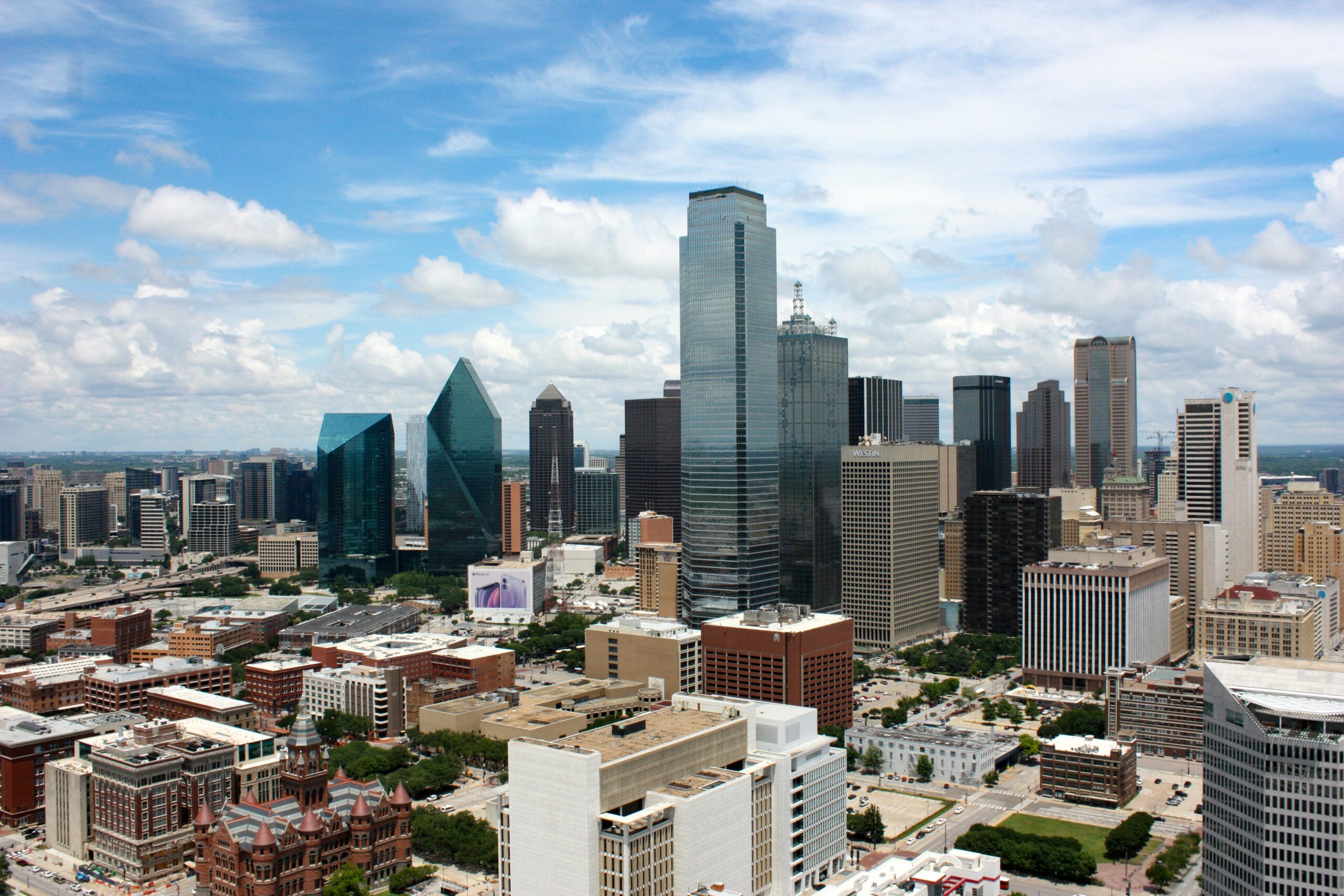
Photo: R K / Unsplash
The Dallas Location and the “All Eggs in One Basket” Problem
The choice of Dallas as a scouting location raises its own questions, and not just the obvious ones about Texas weather.
Concentrating this volume of national airspace infrastructure in a single geographic location creates dependencies that did not previously exist. Power grid reliability. Network connectivity. Physical security. Severe weather exposure — Dallas sits in a region with significant convective weather activity, including tornadoes and severe thunderstorms. These are not exotic risk scenarios. They are routine considerations for any critical infrastructure project.
The counterargument is that modern facility design includes redundant power, redundant communications, and hardened systems. Those mitigations are real. But redundancy within a single building is a fundamentally different proposition than redundancy across multiple geographically separated facilities. The former protects against equipment failure. The latter protects against location failure. They are not the same thing.
Building resilience into one structure is engineering. Distributing resilience across geography is architecture. The current ARTCC system is architectural resilience. A Supercenter trades that architecture for efficiency — and the trade-off deserves far more public scrutiny than it is currently receiving. With Summer 2026 aviation system strain already at record levels, the timing of this infrastructure gamble could not be more consequential.
The Workforce Precedent Nobody Wants to Revisit
This is not the first time the FAA has floated a major ATC consolidation strategy.
A previous attempt at consolidating facilities in the Northeast encountered serious resistance. The facility certification problem was at the core of it: air traffic controllers are not generalist employees. A controller certified at one ARTCC cannot simply relocate to a new Supercenter and resume work. Recertification takes time, training, and simulator hours. Controllers who cannot or will not relocate are either retrained at significant cost or lost from the workforce entirely.
The Northeast experience reportedly resulted in a combination of forced relocations and separations. In a system already running on overtime to cover a staffing shortfall measured in the thousands, losing experienced certified controllers to a consolidation transition is not an administrative inconvenience. It is an operational risk that compounds every other vulnerability the Supercenter creates.
The irony is sharp: a plan designed to make the system more efficient could, in the transition period alone, make the FAA controller staffing shortage measurably worse.
What Happens When It Goes Wrong
If the Supercenter experiences a significant outage — systems failure, cyberattack, severe weather forcing evacuation, power loss beyond backup capacity — the immediate response is airspace closure or transfer to neighbouring facilities. Flights transiting the affected airspace are held. Departure clearances freeze. Arrival rates at airports inside or downstream of the affected region drop to match what the absorbing system can handle.
Ground stops are issued. Traffic Management Initiatives activate. Ground Delay Programs stack up. Gate holds extend. Passengers sit.
The duration of that disruption depends entirely on how quickly the Supercenter can be restored or how effectively neighbouring centres can absorb a workload that was never designed to be theirs. In the current distributed system, a single ARTCC failure is serious but manageable. In a Supercenter model, the equivalent failure is categorically larger — and the absorbing capacity of the remaining network is proportionally smaller, because fewer centres exist.
Photo: Sevcan Alkan / Unsplash
The Efficiency Argument — And Why It Is Not Wrong, Just Incomplete
It is worth being fair to the other side of this.
Consolidating ATC infrastructure does offer real advantages. Unified technology platforms are easier to upgrade and maintain than dozens of independent systems running on different cycles. Centralised training programmes are more efficient. Long-term facility maintenance costs across 22 separate buildings are genuinely significant. The FAA’s infrastructure is ageing, and the capital cost of upgrading every existing centre individually is not trivial.
The argument for consolidation is not irrational. The problem is that efficiency and resilience are in direct tension here, and the public case for this plan has been made almost entirely on efficiency grounds — without a credible, transparent assessment of what the resilience trade-off actually looks like at scale.
That is the gap. Not whether centralisation has merit. But whether a $1.9 billion commitment to a single-facility model has been stress-tested against the failure scenarios it creates — and whether those scenarios have been honestly disclosed to the people who fly through that airspace every day. The higher airfare pressure across the system already has passengers paying more for less resilience. A Supercenter outage scenario would add operational chaos to an already strained consumer experience.
What Needs to Happen Before This Moves Forward
At minimum, three things should be publicly established before this plan advances:
First, a full independent resilience assessment — not an internal FAA study, but an independent evaluation of what a Supercenter outage looks like at various scales, and what absorbing capacity the remaining network retains.
Second, a transparent workforce transition plan — with specific numbers on controller recertification timelines, relocation support, and a credible projection of staffing levels during the transition period.
Third, public disclosure of the failure scenario modelling — how long does a partial outage last? A full outage? What is the knock-on delay impact across the national airspace system? What is the recovery time? These are not classified questions. They are infrastructure planning basics that the flying public has a right to understand.
The Bigger Picture
The Supercenter proposal does not exist in isolation. It sits alongside the FAA’s existing air traffic control staffing crisis — a system already running thousands of controllers short of its own operational targets, already logging over 2.2 million hours of overtime annually, already facing a summer travel season that will stress every hub in the country simultaneously.
Introducing a major infrastructure consolidation into that environment — with the workforce displacement, recertification requirements, and transition risks it carries — is a compounding bet. Each individual element of the plan may be defensible in isolation. Together, they add up to a level of simultaneous systemic change that the national airspace system has rarely been asked to absorb.
That is the risk nobody is discussing. And it is the risk every passenger, every airline, and every policymaker with oversight responsibility for this sector should be asking about — loudly, and before the first shovel goes into the ground in Dallas.